The product

Four screens, one job: know where your money is.

Fortn has a small surface on purpose. Each screen answers exactly one question, and none of them asks you to categorise a receipt from last Tuesday. Every screenshot on this page is the real app.

Savers

What you actually have, box by box.

The inventory. Every box's real balance, grouped by letter in the order the method demands — with the money that has no box yet, your main account, standing at the top as its own number.

  • Balances are derived, never stored. Every number traces back to a ledger line, so there is no second version of the truth to drift.
  • It knows what's already spoken for. Committed bills between now and your next payday are subtracted, so "free" means free.
  • No progress bars. This screen answers stock, not progress — a full bar and a bill due tomorrow are not the same news.
  • Thirty boxes in one sitting. Add multiple builds the whole list first — name, balance, letter — and writes it in one go, so setting up never becomes the thing you'll finish later.
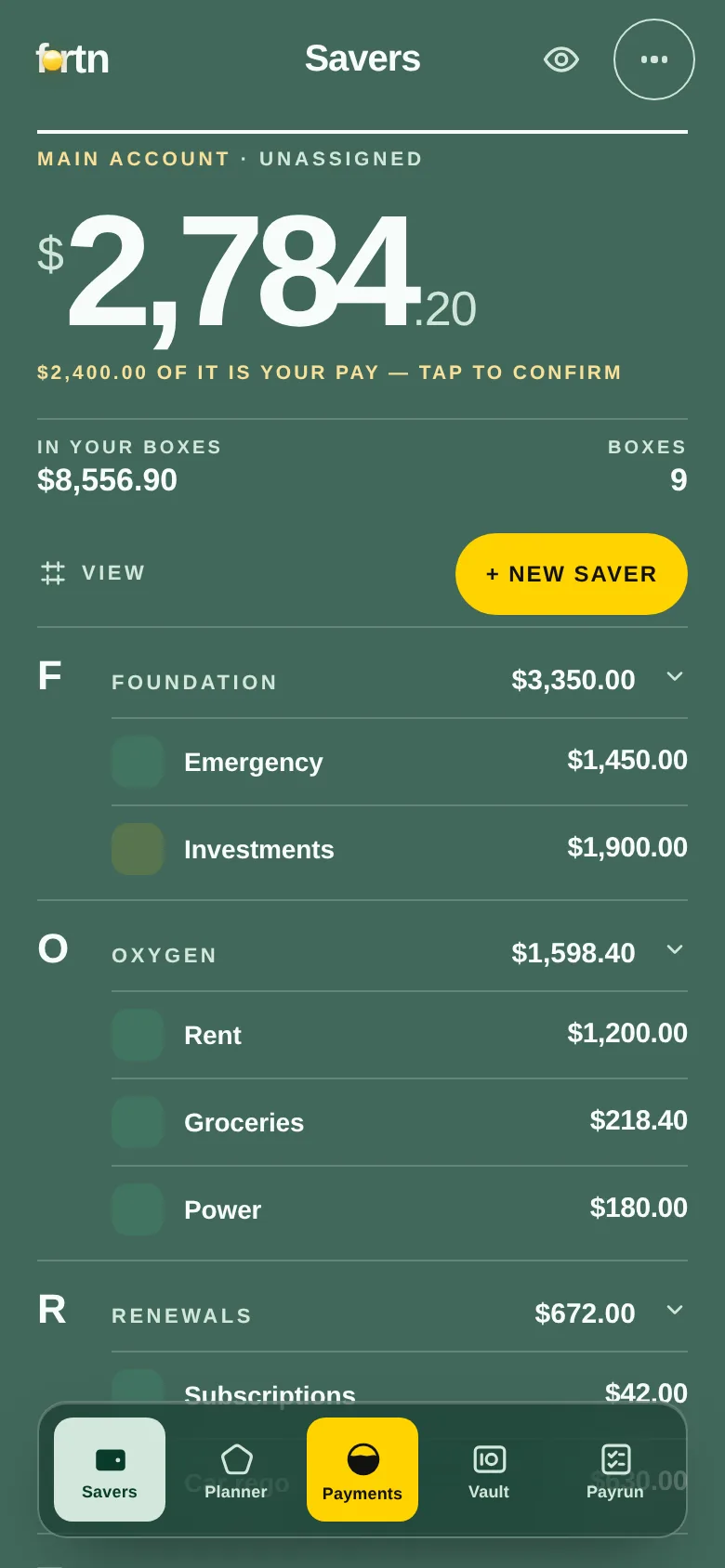
Savers: a main account of $2,784.20 above $8,556.90 held across nine boxes, grouped by letter.

Planner

Set the share once. Watch it hold.

Planner is where you decide what each box gets per pay, and where the method quietly grades you: every letter shows the slice of your pay it is taking, next to the rule it is meant to keep — a floor for Foundation, a ceiling for the rest.

  • It tells you the truth about Oxygen. When the necessities eat 70% of your pay, the screen says so plainly instead of congratulating you.
  • Frequencies convert themselves. A weekly bill and a yearly rego both land correctly in a fortnightly plan — you never divide by 2.17 in your head.
  • The shares are yours to move. 10/60/5/10/15 is where you start, not a rule you're graded against forever.
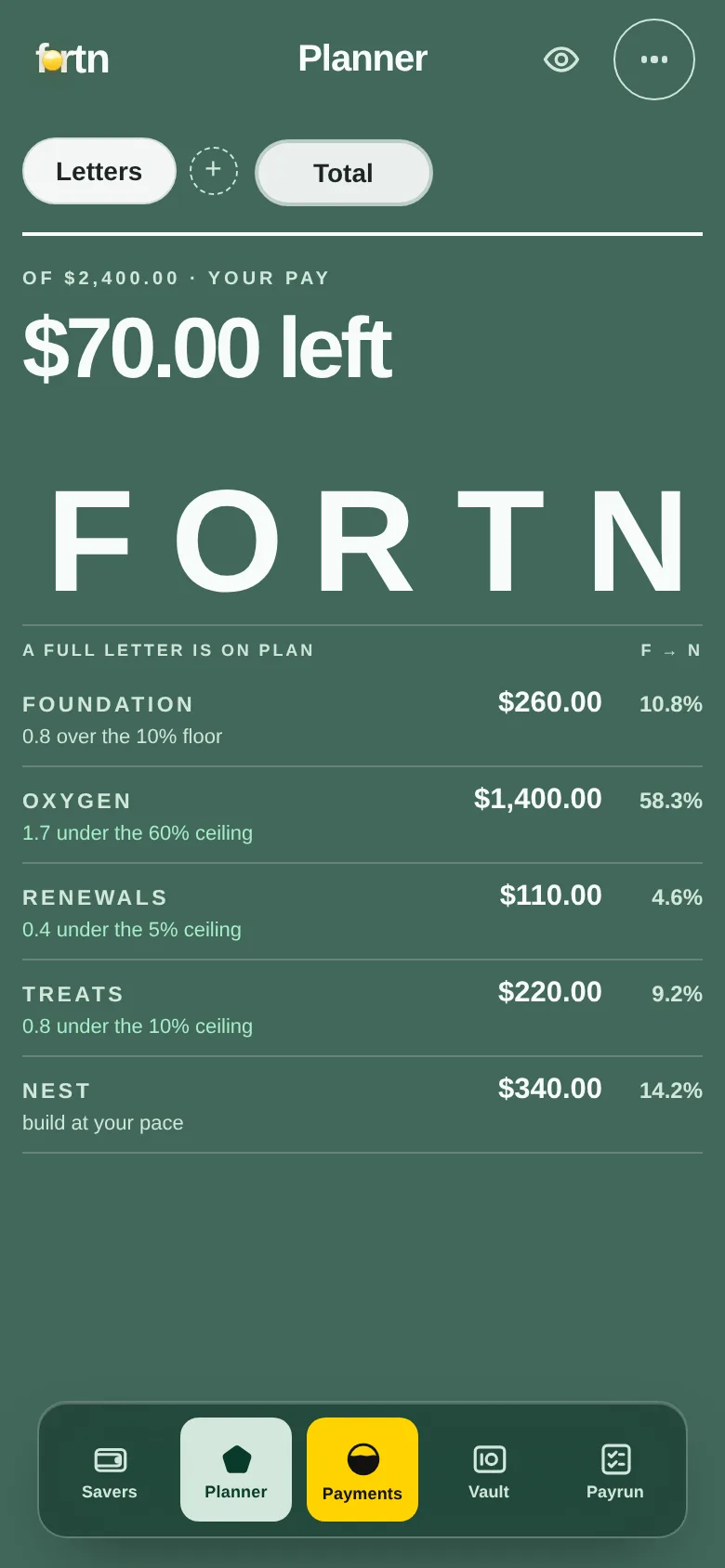
Planner: $70 left of $2,400, with Foundation, Oxygen, Renewals and Treats all inside the method's rule.

Payrun

The one minute that makes it work.

Payday arrives, you enter what actually landed, and tick the boxes as they fill. It's a checklist, not a form, and it is the only ritual Fortn asks of you.

  • Pay that arrives in pieces is normal. Log several deposits in one payrun; the total updates as you go.
  • A short pay doesn't break it. Fortn shows what's missing in amber and still lets you finish — the method decides who goes short, and you can override it.
  • You can walk away mid-payrun. It waits. Half a payrun is a state the app understands, not a crash you recover from.
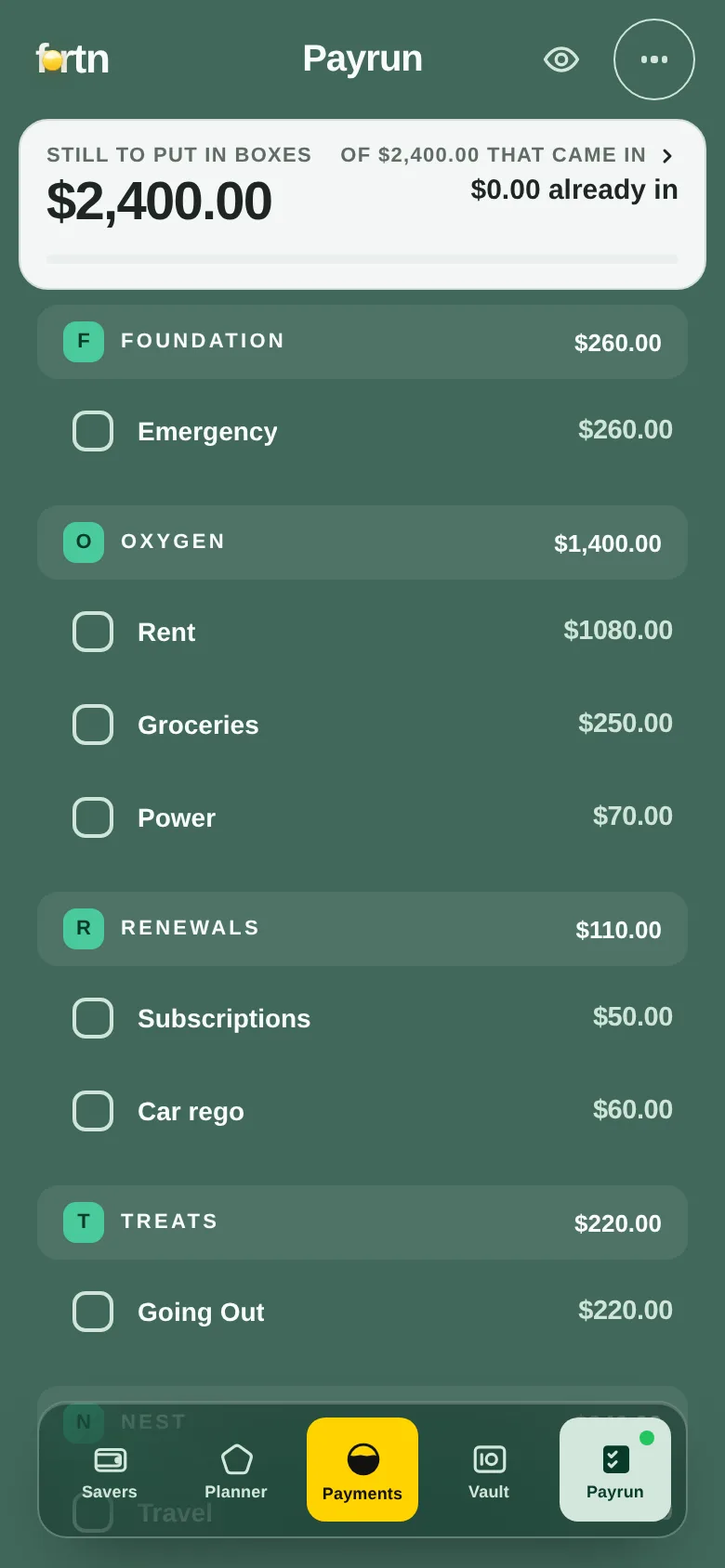
Payrun: $2,400.00 still to put in boxes, with every box listed under its letter waiting to be ticked.

Payments

Spend from a box, not from a blur.

Logging a spend takes about four seconds: a number, a box, done. The five letter balances sit across the top so you always know which part of your life you're spending.

  • Money never opens your phone's keyboard. Fortn has its own keypad, so the OS keyboard can't cover the field you're typing into — and you can do maths in it.
  • Bills that repeat get marked once. Fortn then knows what's still coming before your next payday, and Savers subtracts it.
  • No suggestions inside the fields. You will never see "e.g. Rent" in a Fortn input — one person's life, printed into everyone's app, is not a placeholder.
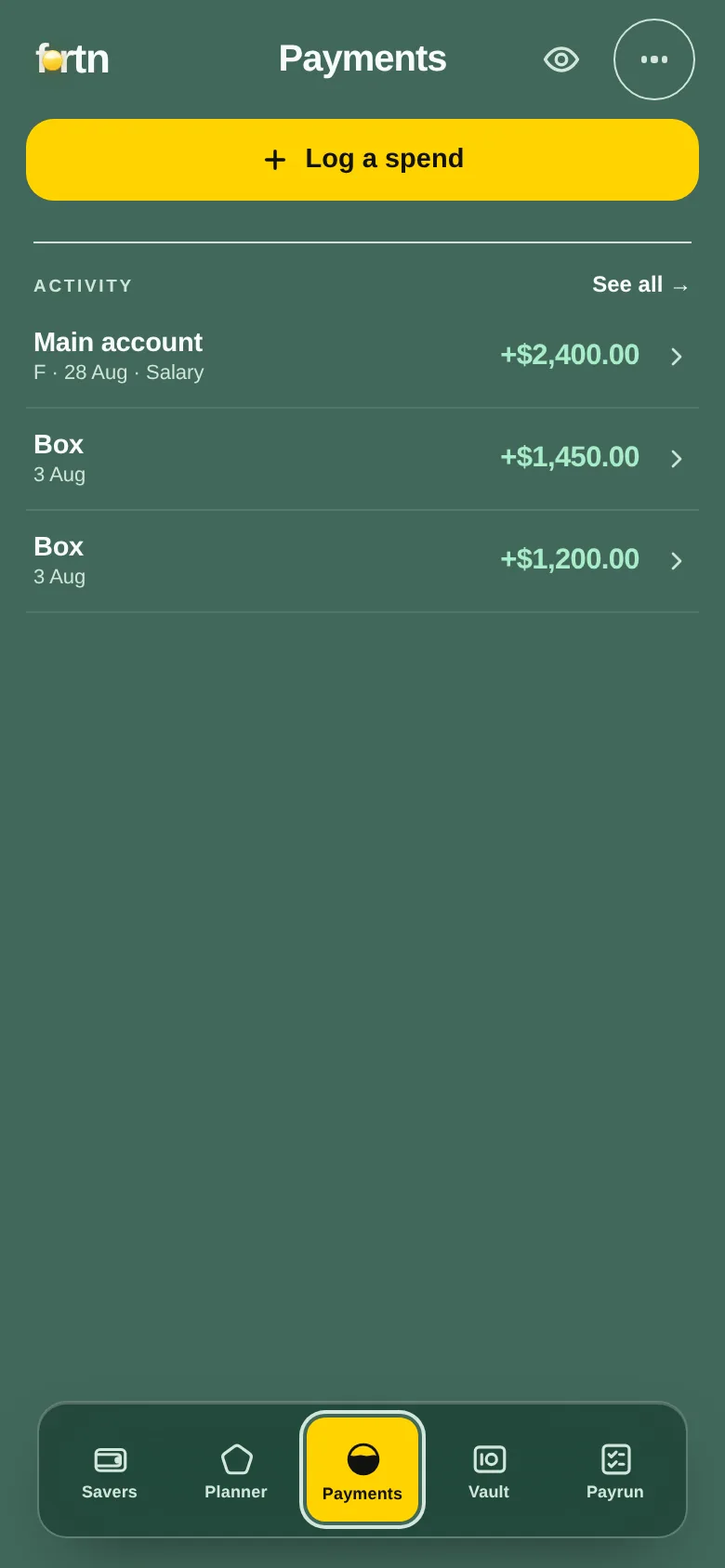
Payments: the five letter balances across the top and Fortn's own keypad for logging a spend.
The Vault

Debts, events, stashes — and the promises between your own boxes.

Debt sits outside the five letters and is paid over the top, because a repayment is not a category of spending. Events are the things you're building toward — a date, what they cost, and whether the box will hold by then. And the internal loan — the one no other budgeting app has — records what one box owes another, in the currency of the box it came from, with a repayment rhythm you choose.

Debt is outside the letters
Paid over the top, and pausable when a fortnight goes wrong.
Progress is money, not instalments
Paying extra moves the bar, because it moved the debt.
Borrow from yourself, on the record
Cover Groceries from Travel and Travel remembers it's owed.
The fifth slot

Two more rooms, for when your life asks for them.

The Vault is one of three things that can hold the last place in the bar. The other two only mean anything once you have months of the app behind you — so they wait, and they arrive because of what you did, not because of a quiz you answered on day one.

Insights — your own book, read back to you

Pick a month or a year and Fortn answers where the money actually went: your pay split across the five letters, then box by box, ordered by what changed most against the period before. A 10% jump in Going Out decides something; a 5% drift in Oxygen doesn't.

Then it says what to do about it — but only when a count in your own ledger fires. Over plan in three of the last five cycles. Rescued by another box twice. A letter over its ceiling, and the box that pushed it there. Never a hunch, never a nag: dismiss one and it stays quiet for three cycles.

It is the one screen that is PRO-only, and for an honest reason — with two payruns behind you there is nothing true for it to say.

Invest — what today's money is worth decades out

Free, and deliberately narrow: Fortn tracks, it never advises. No product names, no promised returns, nothing that reads as "you should buy this". Australia licenses that advice for good reason, and generic tips are already everywhere. What isn't anywhere is the answer using your numbers.

It works in the real rate — your return minus inflation, compounded rather than subtracted — and answers three things with it: what a contribution is worth in today's dollars, how much of the final number is interest rather than money you put in, and the amount you'd need before the money could start paying you instead.

It holds exactly two opinions for your entire life as a user: cover a few months of Oxygen first, and — once that's full — you can start. After that it stops talking and keeps count.

The app fits you

Not everyone needs the whole method on day one.

A 22-year-old in a sharehouse and a family paying off a mortgage do not need the same app. Fortn asks a couple of tap-only questions when you start, and builds itself accordingly — then grows as your life gives it a reason to.

Four screens never move

Savers, Planner, Payments and Payrun are the spine and are always there. Only the fifth slot is personal: the Vault for debts and promises, Insights for the year read back to you, or Invest for what today's money is worth decades out.

Features arrive when you earn them

Put a box in the red and Fortn offers you internal loans. Close two payruns and it offers Insights. The app teaches one idea at a time, triggered by what you did — not by a quiz you answered on day one.

Hiding is never deleting

A feature you haven't switched on is out of the way, not locked. Money that exists is always visible, no matter which features are off. Turning something off can never make a dollar disappear.

The details

Small things, decided on purpose.

Works offline

Install it and it runs with no connection. An account is optional and only exists to sync between devices.

Three themes

Forest, Night and Light. Your phone's status bar takes the colour of the room you're standing in.

Deleting asks where the money goes

Remove a box with a balance and Fortn makes you pick a destination. Money never vanishes for the sake of tidying up.

Australian dollars, properly

Formatted as AUD everywhere, with pay cycles that match how the country is actually paid.

Get Fortn free Compare with YNAB & others →